

Commercial real estate websites built for how tenants and investors search.
Custom Squarespace commercial real estate sites — availability legible, specification complete, track record evidenced, and enquiry routes separated by audience. Fixed price agreed before we start, and you own everything.
In commercial property, the shortlist is built before anyone contacts you.
A tenant rep, an investor or an occupier is filtering on specification: square footage, floor plate, class, location, availability date. If those details are inside a PDF or missing entirely, you are eliminated silently by somebody who never made contact.
Most commercial property websites
The PDF problem
Specification locked inside brochures nobody downloads. Filtering happens on the page, and anything not on the page does not exist.
The three-audience problem
Tenants, investors and vendors all need different information. One undifferentiated site serves whichever the last redesign favoured.
What we build instead
A site with availability and specification published and filterable, track record evidenced with real numbers, and separate routes for each audience.
- Availability
- Published and filterable
- Specification
- On the page, not in a PDF
- Track record
- Real numbers
- Audiences
- A route for each one
Built for how commercial property decisions actually get made
Every element below exists because it changes whether you survive the filter.
Specification published, not attached
Square footage, floor plates, class, availability and terms on the page, filterable. Brochures are for after the shortlist, not before it.
Portfolio with real numbers
Units under management, square footage, transaction values, sectors. Specificity is what establishes standing in this market.
Three audiences, three routes
Occupiers, investors and vendors each given a path, because their questions have almost nothing in common.
Named people with track record
Which broker or manager handles what, and what they have transacted. Clients appoint individuals in this sector.
Findable by market and asset class
Pages targeting submarket, asset class and requirement, matching how tenant reps and investors actually search.
Availability easy to keep current
Structured so your team can update listings and availability the day they change, because stale availability costs credibility fast.
A property business we did this for
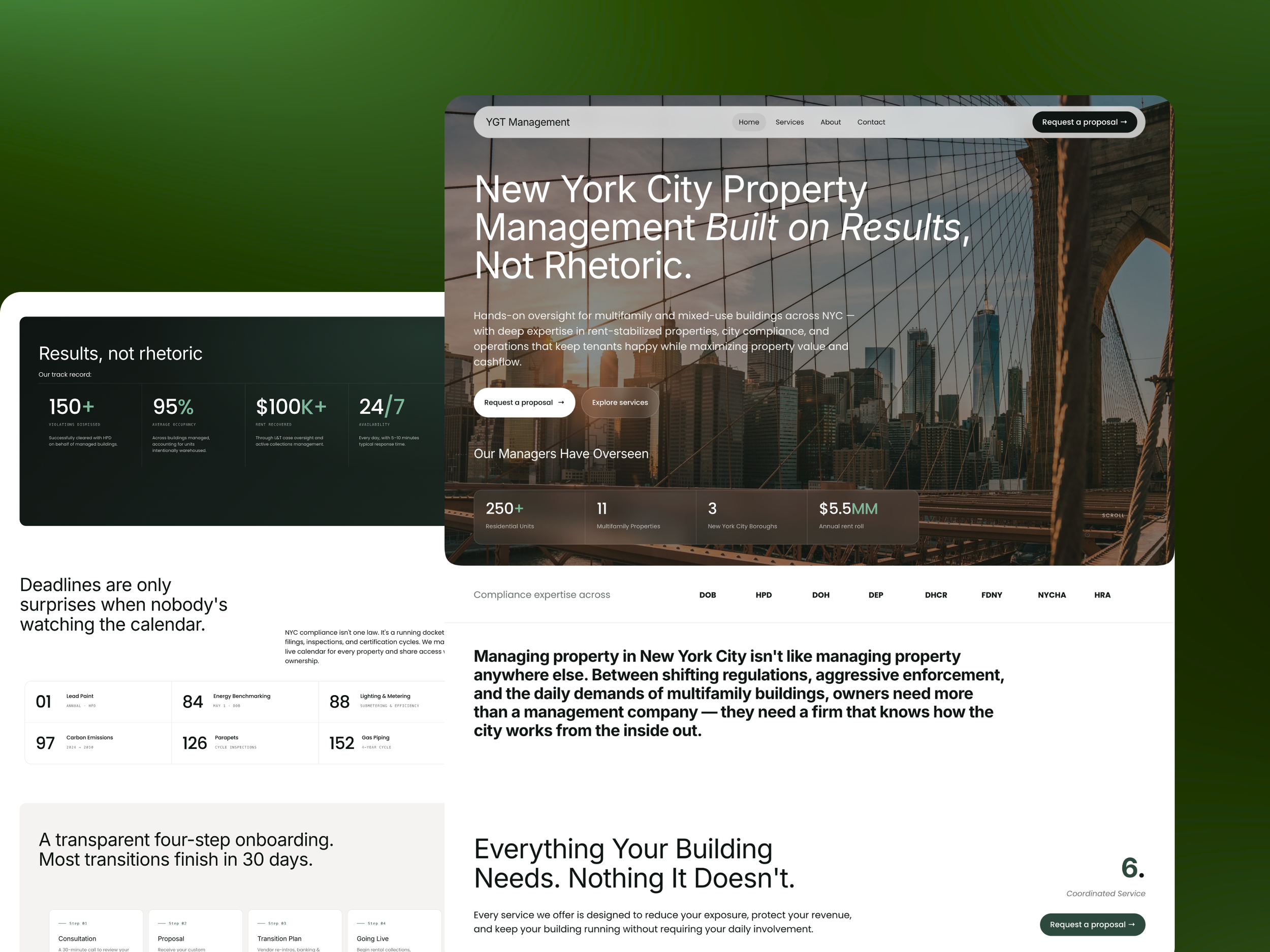
YGT Management
A New York City firm specialising in multifamily, mixed-use and rent-stabilised buildings — 250+ residential units across 11 properties and a $5.5MM annual rent roll, in a market where every competitor looks identical.
Qualified only
Authority through specifics
“Mikkel is truly a one of a kind talent and an all around pleasure to work with. He is more than a freelancer. He’s a businessman himself who made it a point to understand my business. If you can articulate it, he can make it. He is perhaps the clearest communicator of any web designer I have ever worked with.”

Reed B.
YGT Management
How your commercial real estate website gets built
Four stages, in the same order every time. How long each takes depends on the size of the site — you get the timeline in writing before anything starts.
-
01
Discovery
One call and a short form. Which work is most profitable, which you want more of, and what clients ask before they commit.
-
02
Copy first
Every page written for you and sent as a document to review. You approve what the site says before you see how it looks.
-
03
Design & build
Built custom from a blank canvas — desktop and mobile — with SEO, schema and analytics wired in as we go, not bolted on after.
-
04
Launch & handover
If you have an existing site, every URL is redirected so rankings hold. Then training, 30 days of support, and full ownership in your name.
We launch, rebuild, grow and maintain commercial real estate websites.
Two fixed-price projects to get the site right, two monthly retainers to keep it working. Most clients start with a project, then add one retainer.
You have the direction. We build it properly.
For companies with their design and content already settled, or moving from another platform without changing the substance. The thinking is done — this is the part where it gets built and lands without incident.
Everything reconsidered, then rebuilt around it
For companies where the site is not just dated but wrong — the wrong message, the wrong structure, aimed at the wrong buyer. We start with what it should say and work outward from there.
Visibility that compounds instead of resetting
Fewer buyers reach a results page at all now — they ask an assistant and act on the answer. Being the source that answer draws on is the work, and it is won slowly rather than switched on.
The web team you would hire, without the headcount
For companies that want the site run rather than repaired. Someone who knows it inside out, works to your rhythm, and gets to things before you have noticed them.
Grow and Maintain can run together after any project. Not sure which you need? The discovery call settles it in thirty minutes.
Questions commercial real estate firms ask us
Will we lose our current search rankings?
+
No. Every URL is mapped and 301-redirected before launch, including availability pages, and rankings are measured either side.
Why should specification be on the page rather than in a brochure?
+
Because filtering happens before anyone contacts you. Square footage, floor plates, class, availability date and terms need to be visible and filterable — anything locked in a PDF effectively does not exist during shortlisting.
How do we serve occupiers, investors and vendors on one site?
+
Three routes from the first screen. Their questions have almost nothing in common, and one undifferentiated site ends up serving whichever audience the last redesign happened to favour.
What establishes standing in this market?
+
Numbers. Units under management, square footage transacted, deal values, submarkets covered. Specificity is what separates a serious firm from a well-designed one.
Can it connect to our listings platform or CRM?
+
Usually yes. Property feeds and CRM integrations are handled through embeds or connectors, and we scope exactly what your platform supports before quoting rather than discovering limits mid-build.
How do we keep availability current?
+
It is built so your team can update availability the day it changes, from a phone if necessary. Stale availability damages credibility faster than almost anything else in this sector.
Should individual brokers be named?
+
Yes. Clients appoint individuals here, so who handles which submarket or asset class, and what they have transacted, does more than any firm-level statement.
Who writes the content — and can we review it?
+
We write every page and deliver it as a document for your review before design begins, which is when market and asset-class language is easiest to correct.
Can our team update it without a developer?
+
Yes. Availability, brokers, market reports and sector pages are all editable in-house, with a recorded walkthrough of your own site. If nobody has time, there is a management retainer.
What does it cost, and who owns the site?
+
Projects start from $3,750, with the exact figure set by page count, functionality and whether existing content is being migrated. You get a fixed number in writing before anything begins — no hourly billing and no scope surprises. Full detail on the pricing page. You own the result outright: the domain, the Squarespace account and every piece of content are in your name from day one, with no agency lock-in.

Survive the filter
you never see.
Thirty minutes, free. We work out what the site needs to do and tell you straight whether we're the right team for it. Not ready to talk? Have us pull your current site apart on video instead.



