
Fintech websites that look like the safe bet, not the risky one.
Custom Squarespace sites for fintech startups — built so partners, investors and customers all read you as credible, regulated and worth integrating with. Fixed price agreed before we start, and you own everything.
In fintech you are asking people to trust you with money before you have a track record.
Every audience arrives sceptical. Customers want to know their money is safe, partners want to know you will still exist next year, investors want to see you understand the market. A startup site that looks like a startup answers none of it, and in financial services that scepticism is the default position.
Most fintech websites
The unfunded-look problem
A generic SaaS template, gradient blobs, and no mention of regulation or security. It reads as a side project, which is fatal when the product touches money.
The invisible problem
You rank for the product name and nothing else, while the searches that matter — the problem you solve, the integration, the compliance question — go to incumbents.
What we build instead
A site that looks properly funded, surfaces regulatory and security posture early, explains the product without jargon, and gives each audience a route that fits them.
- Impression
- Properly funded
- Regulation
- Surfaced early
- Product
- Explained without jargon
- Audiences
- A route for each one
Built for how fintech buyers actually decide
Every element below exists because it changes whether a sceptical audience takes you seriously.
Regulation and security early
Licensing, compliance posture and security practice surfaced near the top rather than in a footer. In fintech this is the first thing every audience checks.
Looks funded
Design quality that signals a real company with real backing. Money-adjacent products are held to a visibly higher standard than other software.
Product explained without jargon
What it does and who it is for, in language a non-technical buyer follows. Fintech copy defaults to abstraction and loses the deal early.
Three audiences, three routes
Customers, partners and investors all need different things. One undifferentiated homepage serves whichever one shouted loudest internally.
Integration made obvious
Docs, APIs and technical detail reachable in one click for the engineer evaluating you, without cluttering the commercial pages.
Fast and flawless on mobile
A slow or broken interface is read as a product risk in this sector in a way it is not elsewhere.
A fintech we did this for
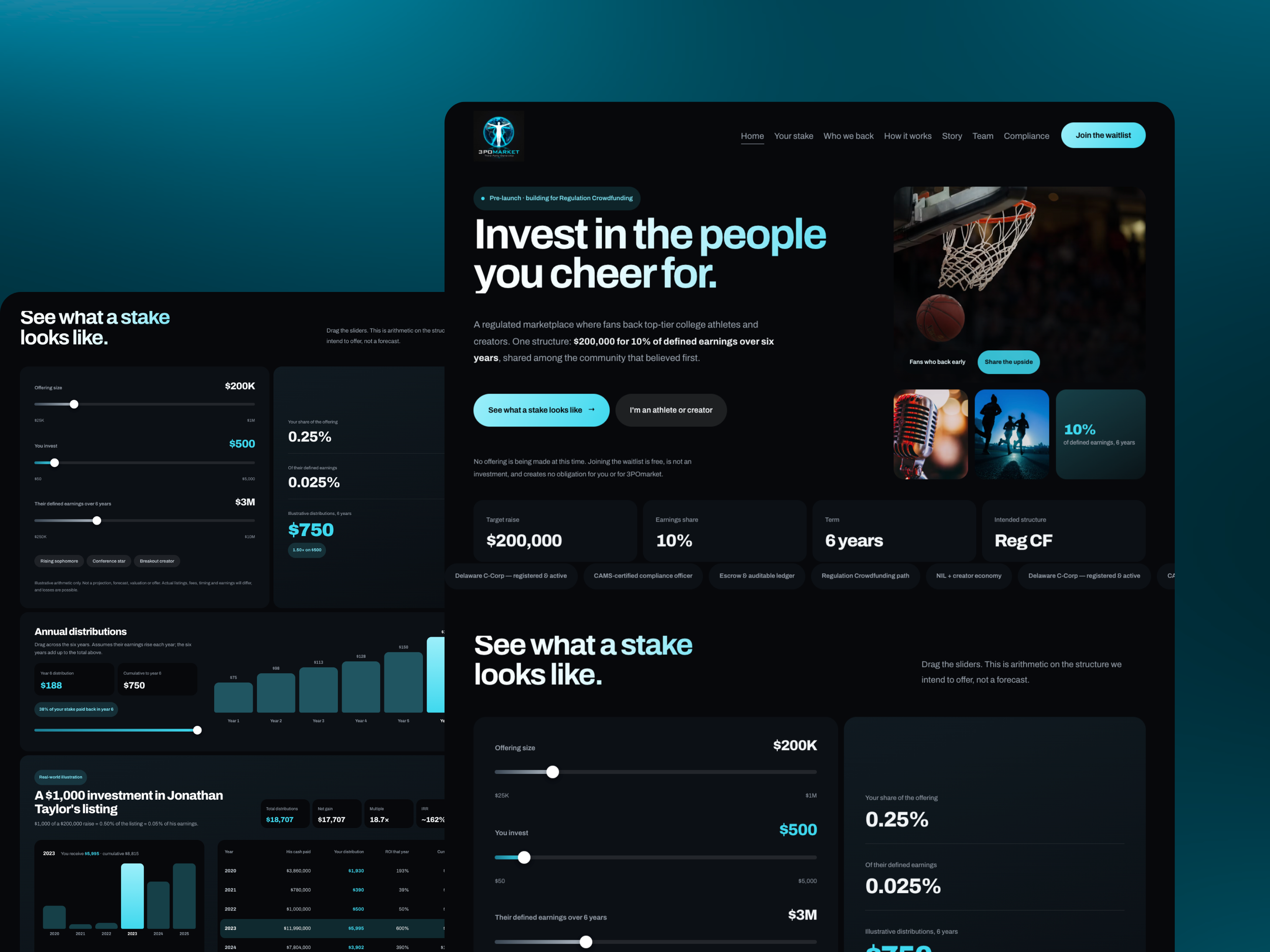
3POmarket
A pre-launch, Reg CF marketplace where fans invest in college athletes and creators. The site had to feel institutional before the platform existed, with every claim worded for the regulation.
Looks funded
Compliance-aware
★★★★★

Anthony A.
3POMarket
How your fintech website gets built
Four stages, in the same order every time. How long each takes depends on the size of the site — you get the timeline in writing before anything starts.
-
01
Discovery
One call and a short form. Which work is most profitable, which you want more of, and what clients ask before they commit.
-
02
Copy first
Every page written for you and sent as a document to review. You approve what the site says before you see how it looks.
-
03
Design & build
Built custom from a blank canvas — desktop and mobile — with SEO, schema and analytics wired in as we go, not bolted on after.
-
04
Launch & handover
If you have an existing site, every URL is redirected so rankings hold. Then training, 30 days of support, and full ownership in your name.
We launch, rebuild, grow and maintain fintech websites.
Two fixed-price projects to get the site right, two monthly retainers to keep it working. Most clients start with a project, then add one retainer.
You have the direction. We build it properly.
For companies with their design and content already settled, or moving from another platform without changing the substance. The thinking is done — this is the part where it gets built and lands without incident.
Everything reconsidered, then rebuilt around it
For companies where the site is not just dated but wrong — the wrong message, the wrong structure, aimed at the wrong buyer. We start with what it should say and work outward from there.
Visibility that compounds instead of resetting
Fewer buyers reach a results page at all now — they ask an assistant and act on the answer. Being the source that answer draws on is the work, and it is won slowly rather than switched on.
The web team you would hire, without the headcount
For companies that want the site run rather than repaired. Someone who knows it inside out, works to your rhythm, and gets to things before you have noticed them.
Grow and Maintain can run together after any project. Not sure which you need? The discovery call settles it in thirty minutes.
Questions fintech startups ask us
Will we lose our current search rankings?
+
No. Every URL is mapped and 301-redirected before launch, and rankings are measured either side so anything bringing in traffic keeps working.
How early should regulation and security appear?
+
Near the top. Licensing, regulatory status, security practice and certifications are the first things every audience checks in fintech, and burying them in a footer costs you credibility you have already earned.
Does design quality really matter more for us?
+
Yes. Money-adjacent products are held to a visibly higher standard, and a cheap-looking site suggests an underfunded company. Nobody integrates payment infrastructure with a company they think might fold.
We sell to customers, partners and investors. How does one site serve all three?
+
Three routes from the first screen. Their questions have almost nothing in common, and one undifferentiated homepage tends to serve whichever audience shouted loudest internally.
How important are the docs?
+
More than most founders assume. Commercial buyers ask their engineers before committing, so documentation and API detail need to be one click away — reachable without cluttering the commercial pages.
Will compliance need to review the copy?
+
Yes, and that is built in. Copy is delivered as a document for compliance review before any design work begins, which in a regulated sector is not optional.
Can Squarespace handle a fintech marketing site?
+
Comfortably. The marketing site and the regulated product are separate concerns — Squarespace runs marketing, content and docs entry points while your platform stays where it is.
How do we look funded before we are?
+
Restraint and specificity rather than volume. Clear positioning, real screenshots, named team, evidenced security. Overstatement is what reads as underfunded, not simplicity.
Can we update it without a developer?
+
Yes. Landing pages, partner pages, compliance updates and blog are all editable in-house, with a recorded walkthrough. Where compliance sign-off comes first, the management retainer handles publishing.
What does it cost, and who owns the site?
+
Projects start from $3,750, with the exact figure set by page count, functionality and whether existing content is being migrated. You get a fixed number in writing before anything begins — no hourly billing and no scope surprises. Full detail on the pricing page. You own the result outright: the domain, the Squarespace account and every piece of content are in your name from day one, with no agency lock-in.
Insights for fintech startups











Be the fintech they trust.
Thirty minutes, free. We work out what the site needs to do and tell you straight whether we're the right team for it. Not ready to talk? Have us pull your current site apart on video instead.