A model portfolio website has one main reader: a casting director, booker or agent with a brief and very little time. They are not browsing for pleasure. They are checking whether you fit, how you look without styling, whether your measurements are right and how to book you. A model portfolio website that answers those questions in seconds gets you considered. One that makes them hunt gets closed.
This guide covers what to include, how to lay it out and what the websites of leading modelling agencies teach about presenting talent. It is written for independent models, models building a presence alongside an agency, and the agencies that represent them.
Why your own portfolio site still matters
Social media is where many models are discovered, but it is a poor portfolio. Posts are mixed with personal life, the order is set by the algorithm, measurements and contact details are hard to find, and a casting director can't see your best work in one place. A website gives you one clean link that shows exactly what a professional needs.
It also protects you. Your Instagram account can be restricted or lost. A website on your own domain is yours, and it looks more professional when you send it to an agency or a client.
Who reads it, and what they want
Casting directors and clients want to see your look, range and measurements quickly, and know how to book you.
Agencies scouting new faces want natural digitals, your stats, your age and location and some sense of your personality.
Photographers and brands looking for collaborations want to see your strongest editorial and commercial work.
All of them scan rather than read. Every decision on the site should make scanning faster.
What to include
Your best images, edited hard
Choose fewer images than you think. Ten to twenty strong images that show range (editorial, commercial, beauty, full length, movement) are more convincing than a hundred similar ones. Lead with your strongest image, and show the face clearly in the first few. Remove anything outdated: if your hair, look or body has changed, the portfolio should show you as you are now.
Digitals
Digitals, sometimes called polaroids, are simple unretouched photos in plain clothes and natural light: front, side and back, full length and close up, with no or minimal make up. Agencies and casting directors rely on them to see what you actually look like. Give them their own clearly labelled section, and update them regularly.
Your stats
List your height, bust or chest, waist, hips, shoe size, hair colour and eye colour, plus dress or suit size if relevant. Use the units your market expects, or both. Put them next to your images so nobody has to search, and keep them accurate. Wrong measurements waste a booker's time and damage trust.
Experience and clients
A short list of clients, campaigns, publications and shows you have worked on, most recent first. If you are new, skip this rather than padding it. A strong set of images and digitals matters more than a list.
Video
A short clip of you walking, moving or speaking to camera shows things a still image can't. Keep it short and natural.
Location and availability
Where you are based and where you can travel or work. Clients often book by city.
Contact, done safely
A clear way to get in touch: your agency's booking contact if you are represented, or a professional email address and a simple contact form if you are not. Avoid publishing your home address or a personal phone number.
What the top agencies' websites teach
Modelling agencies build their websites for exactly the reader your portfolio serves, so they are worth studying.
IMG Models: the latest work first
IMG Models opens with its latest work and covers, with each card showing a photo, the model's name and the campaign or show, such as a designer's season. The roster is labelled "Model", "Development" and "Talent", a territory menu covers its cities, and a "Get Scouted" link sits in the top bar alongside a recruitment warning and an under 18 FAQ in the footer.
What to borrow: label your recent work with the client or publication. "Campaign for a named brand" carries more weight than an untitled image.
Storm Management: boards for every kind of model
Storm Management divides its menu into women and men, each with boards such as mainboard, new faces and curve, plus a separate talent section and an "Apply" link. A search overlay filters "All Models" by women, men and talent, and booking contacts are split by board.
What to borrow: be clear about which kind of work you do (fashion, commercial, fitness, curve, parts) so the right clients recognise you straight away.
NEXT Management: the city first
NEXT Management organises its roster by city first, from New York and London to Milan and Paris, then by division, with filters for mainboard and new faces. It also shows a prominent warning about people falsely claiming to represent the agency, stating that it will never ask for payment or for nude or undergarment photos.
What to borrow: state your location clearly, and if you are building your own portfolio, learn from the warning: genuine agencies don't charge to represent you.
Wilhelmina: a clear way in for new faces
Wilhelmina puts "BECOME A MODEL" in its top bar, next to a talent search, with its roster split by city and a digital division.
What to borrow: if you want agency representation, look for a clear application route like this and follow its instructions exactly. Most agencies ask for simple digitals, not professional shoots.
How to lay it out
Keep the structure simple
Most modelling portfolios need only a few pages: portfolio, digitals, about with stats, video if you have it, and contact. A single long page can also work if it is clearly divided. The menu should be short and the stats always one click or one scroll away.
Let the photography carry the colour
A dark or plain neutral background with simple type keeps attention on the images. Avoid busy patterns, heavy effects or slideshows that move on their own; casting directors want to look at your photos at their own pace.
Design for the phone
Many bookers check portfolios on a phone between appointments. Make sure images load quickly, galleries can be swiped and your stats and contact details are easy to find on a small screen.
Update it constantly
An out of date portfolio is worse than none. Add new work as soon as you have it, replace old digitals every few months and keep your measurements current. Choose a platform you can update yourself in minutes.
For agencies: what talent looks at
Agencies have a second audience that individual models don't: the talent they want to sign. A model choosing between two agencies looks at their websites the way a client would, and asks different questions. Does this agency represent people like me? Are its models working, with recent campaigns and covers? Does it look like the kind of fashion I want to be part of? Is it clear and safe to apply?
An agency site answers those with a visible, current roster, recent work labelled with the client or publication, a clear application page with simple instructions, and safety information for under 18 applicants and their parents. IMG Models' under 18 FAQ and NEXT Management's warning about people falsely claiming to represent it both reassure prospective talent as much as clients.
Keep personal details private
Your portfolio is public, so think about what it reveals. Don't publish your home address, your date of birth or your personal phone number, and be careful with photos that show where you live. If you are under 18, the site should be managed with a parent or guardian, and contact should go through them or your agency.
Your website and your comp card
A comp card (or zed card) is the printed or PDF summary models leave with clients: a few images, your name, stats and agency contact. Your website should match it. Use the same strongest images, the same measurements and the same contact details, so a client who picks up your card and then visits your site sees one consistent person. Offer the comp card as a download on your site, and put your web address on the card. When you update one, update the other the same day.
Getting found: simple search basics
Most people who visit your portfolio will already know your name, from an agency, a card or a social profile. So the most important search to win is your own name. A few simple steps help:
Put your name in the page title and main heading, with "model" and your city, for example "Your Name, Model, London".
Describe your images in their alt text, such as "Your Name, editorial beauty shoot", so search engines and screen readers understand them.
Write a short paragraph about yourself. A site with no words at all gives search engines nothing to work with.
Link to your site from your social profiles and agency page, and ask photographers you work with to credit and link to you.
Keep it fast. Large, unoptimised images are the most common reason portfolio sites load slowly, and slow sites lose both visitors and rankings.
You don't need a blog or long articles. A clear name, a few well described images and a fast site are enough for most models to show up when someone searches for them.
How Noir Elite Models did it
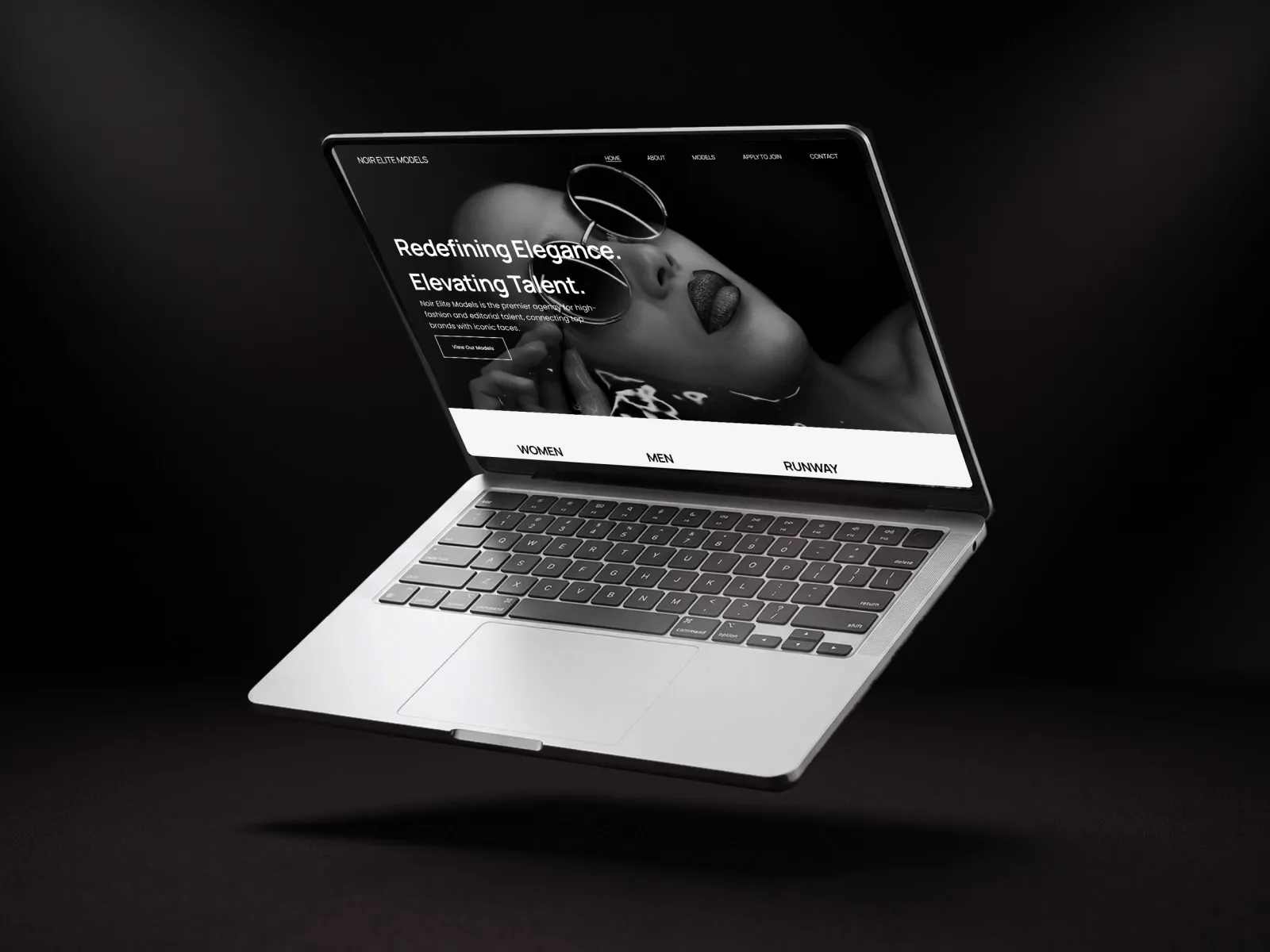
Noir Elite Models is a fashion modelling agency we designed a website for. It represents talent across women, men and runway divisions, with new faces added constantly. The site had to serve casting directors who scan rather than read, and still look like fashion, because an agency that looks like a database doesn't attract the talent it needs to sign.
We built the roster as a structured collection, with divisions, latest additions and individual talent pages, so casting directors can filter instead of scrolling one long page. The design is dark and high contrast, with the only colour coming from the photography. New signings are given prominence because a visibly active roster convinces both clients and prospective talent, and the team adds and updates talent themselves, often the day they sign. The site went live five weeks after kick-off, including the content management build. The Noir Elite Models case study has the full story.
Common model portfolio mistakes
Too many images. Edit to your strongest and most varied work.
No digitals. Agencies and casting directors want to see you unretouched.
Stats missing or out of date. They are often the first thing a booker checks.
Old photos. Your portfolio should show how you look now.
Contact details hidden. Make it easy to book you, safely.
Slow pages full of huge images. Size images properly so the site loads quickly on a phone.
Paying anyone who promises representation. Genuine agencies don't charge to represent you.
Questions models often ask about their website
Should I use my own name as the domain?
Usually yes. Your name is what clients and agencies will search for, and a domain with your name looks professional on a comp card or in an email. If it is taken, add "model" or your city.
Do I need professional photos to start?
Not to apply to agencies. Most ask for simple, natural digitals. For your own portfolio, a few strong test shoots with photographers will do more than many weak images.
Can I have a website if I am signed to an agency?
Often yes, but check your contract and agree with your agency how bookings are handled. Many represented models link their portfolio to their agency's booking contact.
Conclusion
A good modelling portfolio is a working tool. It shows your strongest, most current images, simple digitals, accurate stats, a little video, where you are based and how to book you, safely. It loads fast on a phone, keeps the design out of the way of the photography and is updated whenever something changes. The best modelling agencies' websites do the same at scale: latest work first, a clear structure by division and city, and an obvious way in for new faces.
Start with your stats and digitals. If a casting director can't find your current measurements and an unretouched photo within ten seconds, fix that before adding a single new editorial image.
FAQ
What should a model portfolio website include?
Your strongest and most current images, a set of unretouched digitals, accurate stats (height, measurements, shoe size, hair and eye colour), a short list of clients if you have them, a short video, your location and a safe way to contact you or your agency.
How many photos should a modelling portfolio have?
Usually ten to twenty strong images showing range, plus a separate set of digitals. Fewer, better images make a stronger impression than many similar ones.
What are digitals or polaroids?
Simple, unretouched photos of a model in plain, fitted clothes and natural light, with little or no make up: front, side and back, full length and close up. Agencies and casting directors use them to see what a model actually looks like.
Do models need a website if they have Instagram?
A website is still worth having. It gives casting directors and agencies one clean link with your best work, digitals, stats and contact details, without personal posts or the algorithm deciding what they see first. It also belongs to you.
How do modelling agencies show their roster online?
The leading agencies split their roster by division, such as mainboard, new faces and talent, and often by city, with individual pages for each model. Noir Elite Models' roster is built as a structured collection so casting directors can filter instead of scrolling.
Should a model pay to be represented by an agency?
No. Genuine agencies make money from commission on bookings, not from fees to join. NEXT Management's website warns that it will never ask for payment, and that kind of warning is worth taking seriously.