



The best copywriter portfolio examples all understand one thing: for a writer, the website is the first work sample. A client reads your homepage before they read anything you wrote for someone else. If it sounds like every other freelancer, the portfolio behind it has to work twice as hard.
The seven sites below prove the writing in different ways. Some lead with a grid of client projects. Some lead with results. Some barely show client work at all and let a newsletter do the persuading. For each one we say what it does well and what you could borrow. Everything described is visible on the live sites as of November 2026.
What makes a copywriter portfolio work
Clients hiring a writer want answers to three questions: can you write, can you write for someone like me, and can I trust you with a deadline? The best portfolios answer all three quickly.
Three things show up again and again:
A homepage line that sounds like the writer. The first sentence is the first sample.
Proof in the form clients trust. Named projects, results or a large audience of readers.
A clear next step. One way to hire, made obvious.
Portfolios that lead with client work
1. Tom Albrighton: a project grid that shows range
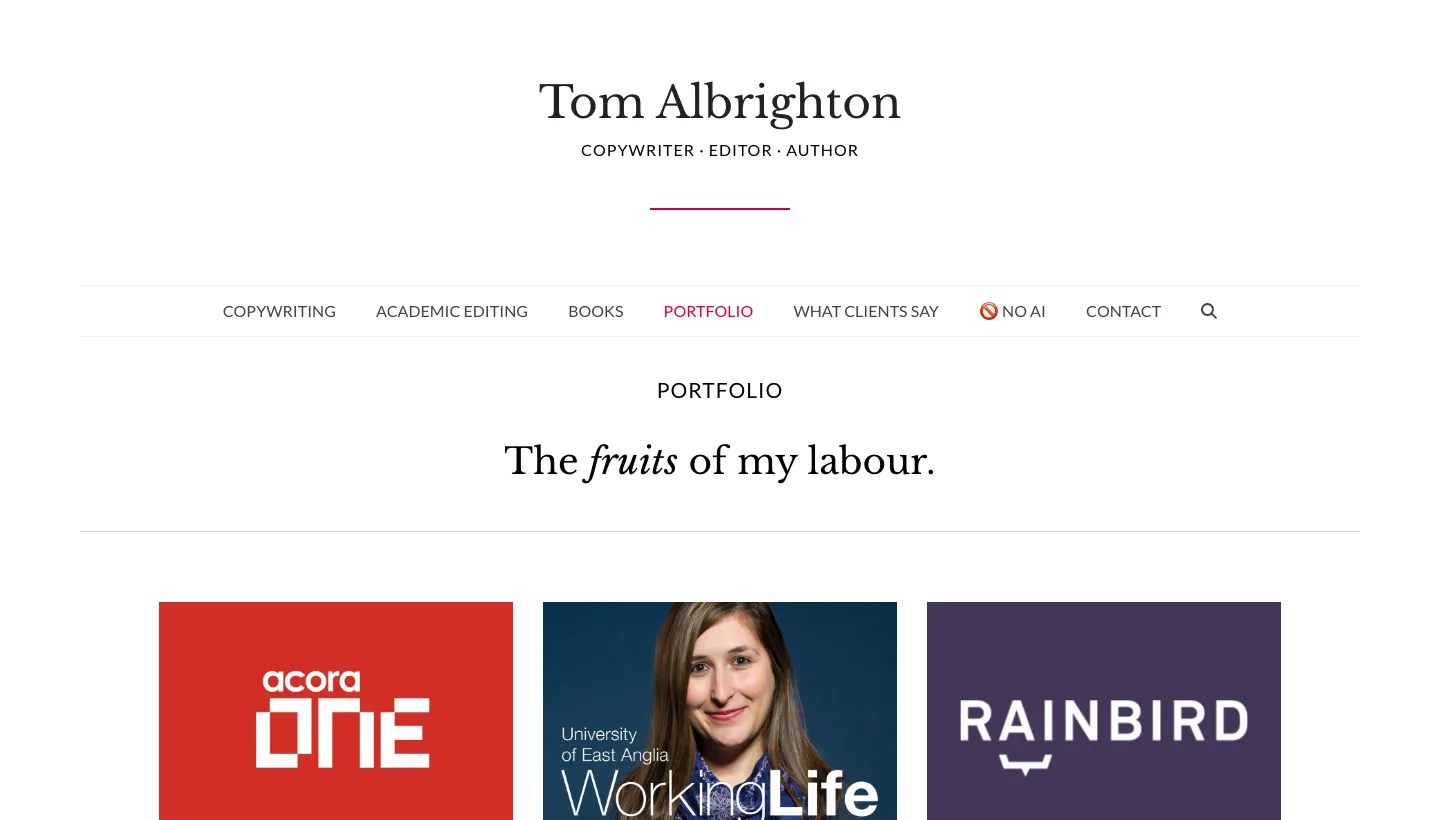
Tom Albrighton's portfolio is titled "The fruits of my labour." and shows each project as a tile with a short line underneath, from Prudential annuity emails to HelloFresh campaign copy and a Jeyes UK website. His homepage opens with "I'll choose your words carefully." and says he has been a freelance copywriter and editor for over two decades, with more than 500 clients.
The grid works because each tile has a name a client recognises or a line that explains the job in a few words. A visitor can scan the range in seconds.
Borrow this: give every portfolio piece a one-line description of the job it did, not just a client name.
2. Jacob McMillen: results first, samples second
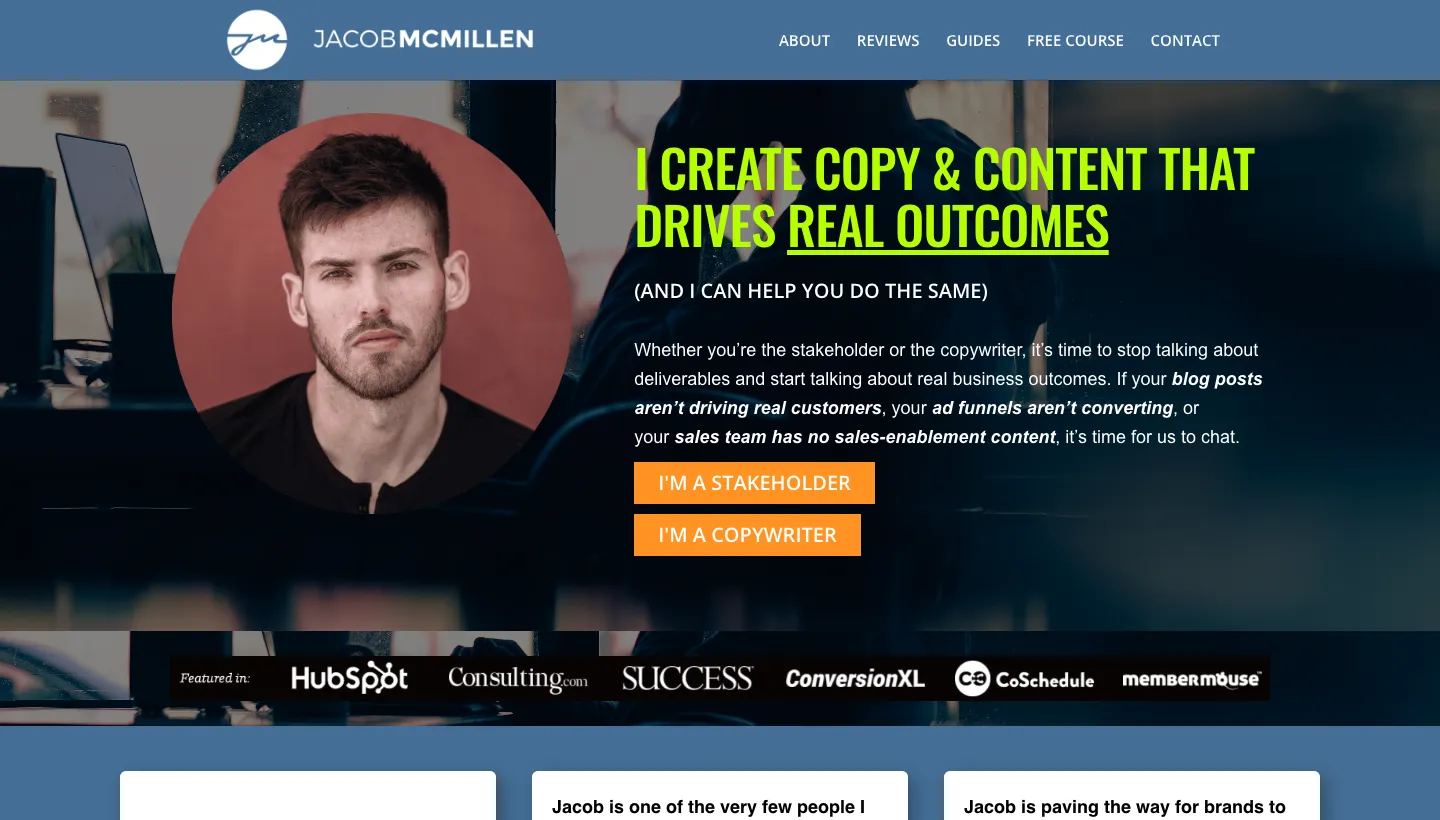
Jacob McMillen opens with "I create copy & content that drives real outcomes" and two buttons: "I'm a stakeholder" and "I'm a copywriter". Further down, he lists results such as "$1M ARR from organic traffic in 18 months" alongside testimonials from marketing leaders.
Business owners hiring a writer often care more about outcomes than prose. Leading with numbers speaks their language, and the two buttons route clients and fellow writers to different parts of the site.
Borrow this: if you can share results, put three of them near the top, each with a number and a timeframe.
Portfolios where the voice does the selling
3. Laura Belgray: personality on every line
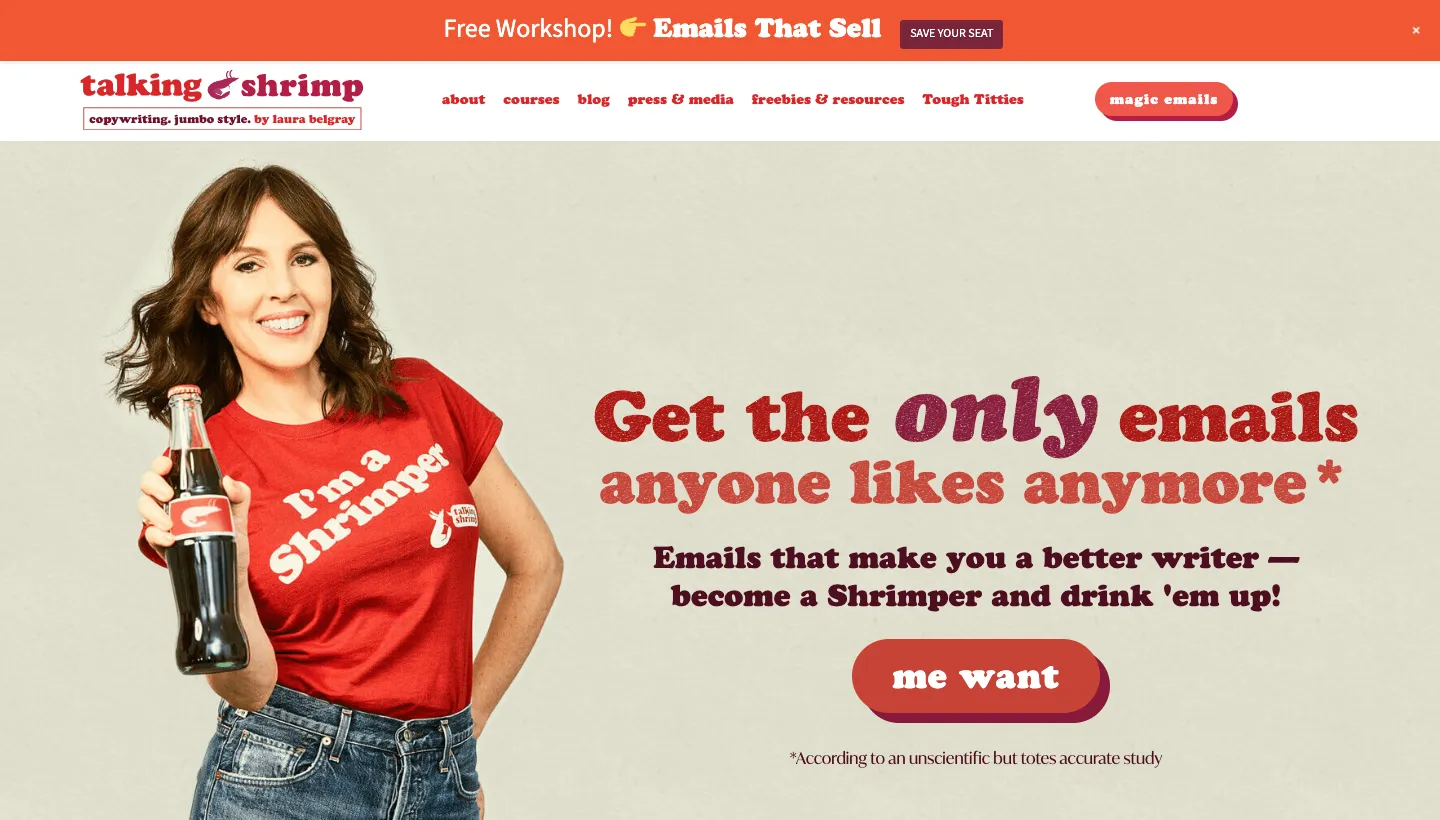
Talking Shrimp, Laura Belgray's site, uses the tagline "copywriting. jumbo style." and opens with "Get the only emails anyone likes anymore*", with the asterisk explained underneath in a joke. Testimonials from Marie Forleo and Amy Porterfield sit further down.
Every line sounds like one person. For a writer who sells a voice, that is the portfolio: a client who likes the homepage already knows what they will get.
Borrow this: rewrite your homepage headline in the voice you want clients to hire, not the voice you think a business site should have.
4. Gary Does Copy: a CV with a pulse
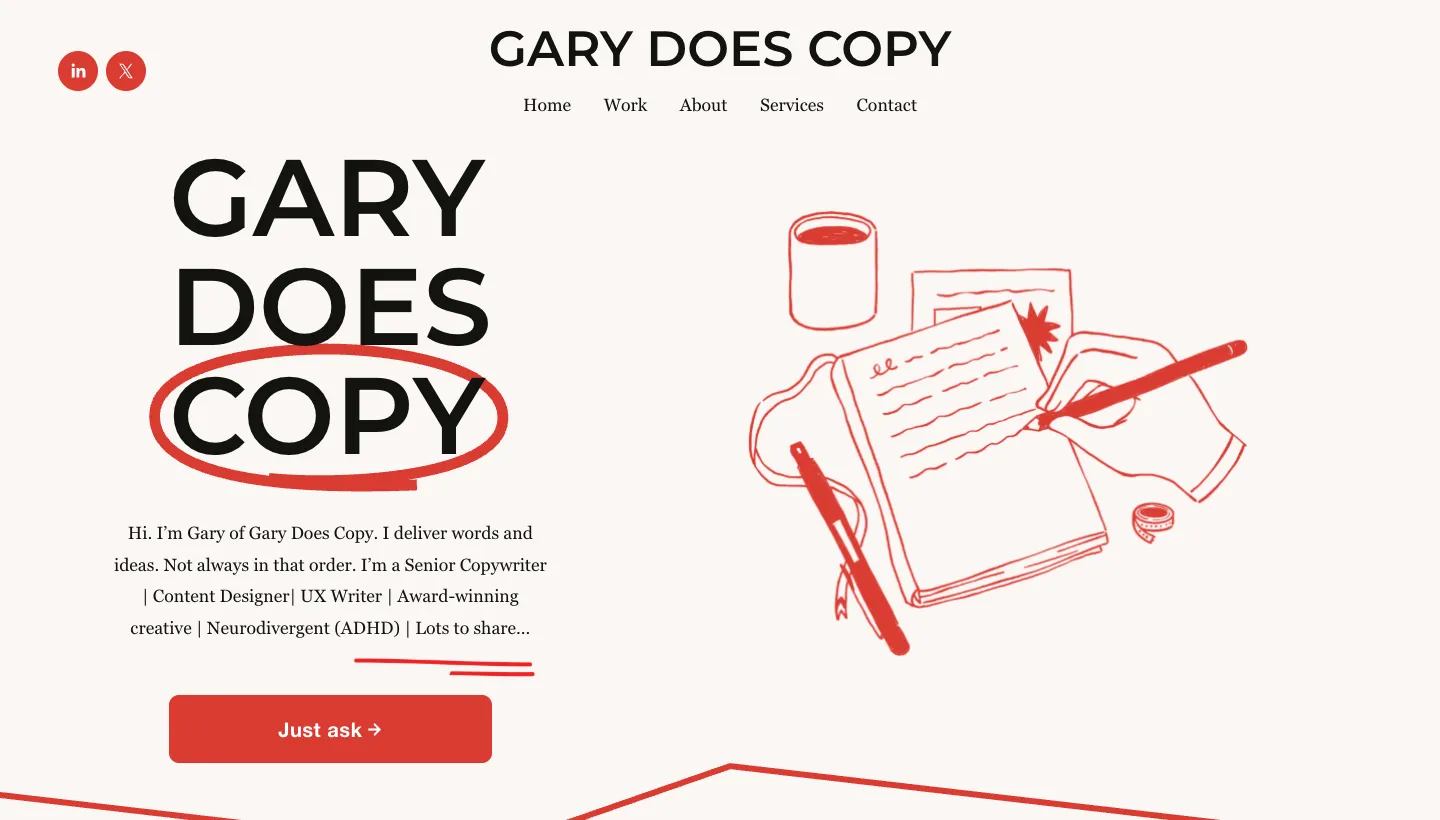
Gary Does Copy is a site we designed. Gary's old site flattened a playful, sharp personality into a services page. The new one opens with "GARY DOES COPY" set large and a hand-drawn illustration, then a series of sections like "Gary Does B2B & Tech Copy" that explain what he does in his own voice. His work page is honest that NDAs kept many projects out of reach, and lists brands he has worked with instead, including British Gas and 3M.
It works as a CV, a portfolio and a demonstration of how he thinks, all at once.
Borrow this: if NDAs limit what you can show, say so plainly and list the brands and agencies you have worked with.
Portfolios built on an audience
5. Eddie Shleyner: the newsletter is the portfolio
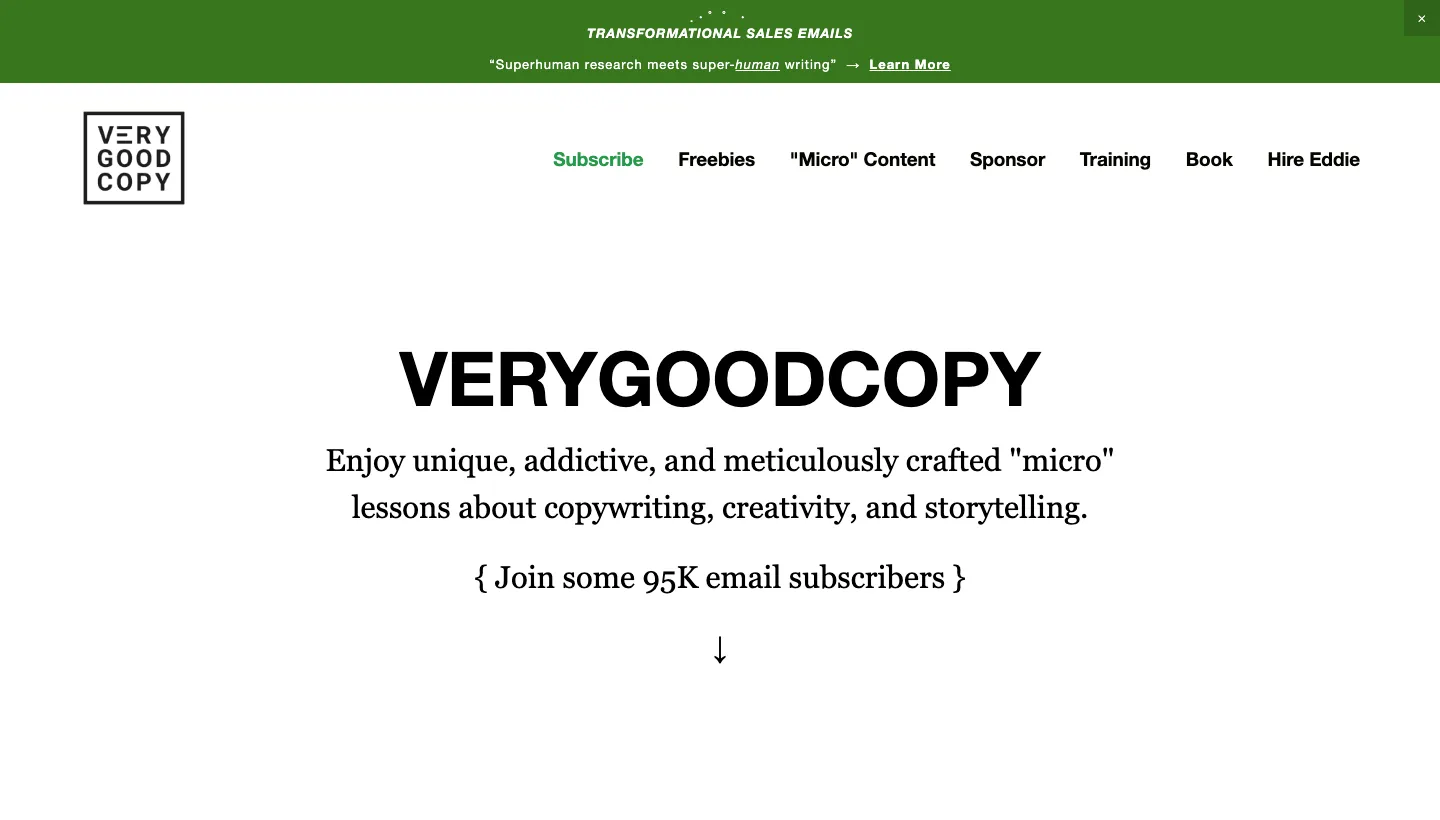
VeryGoodCopy, Eddie Shleyner's site, leads with "micro" lessons about copywriting, creativity and storytelling and an invitation to "Join some 95K email subscribers". The navigation still includes "Hire Eddie", and the footer notes that the website copy and design are his own.
Tens of thousands of readers choosing to read your writing every week is strong proof that you can hold attention.
Borrow this: if you write a newsletter, show the subscriber count and make the hire link easy to find.
6. Ann Handley: the writer as a brand
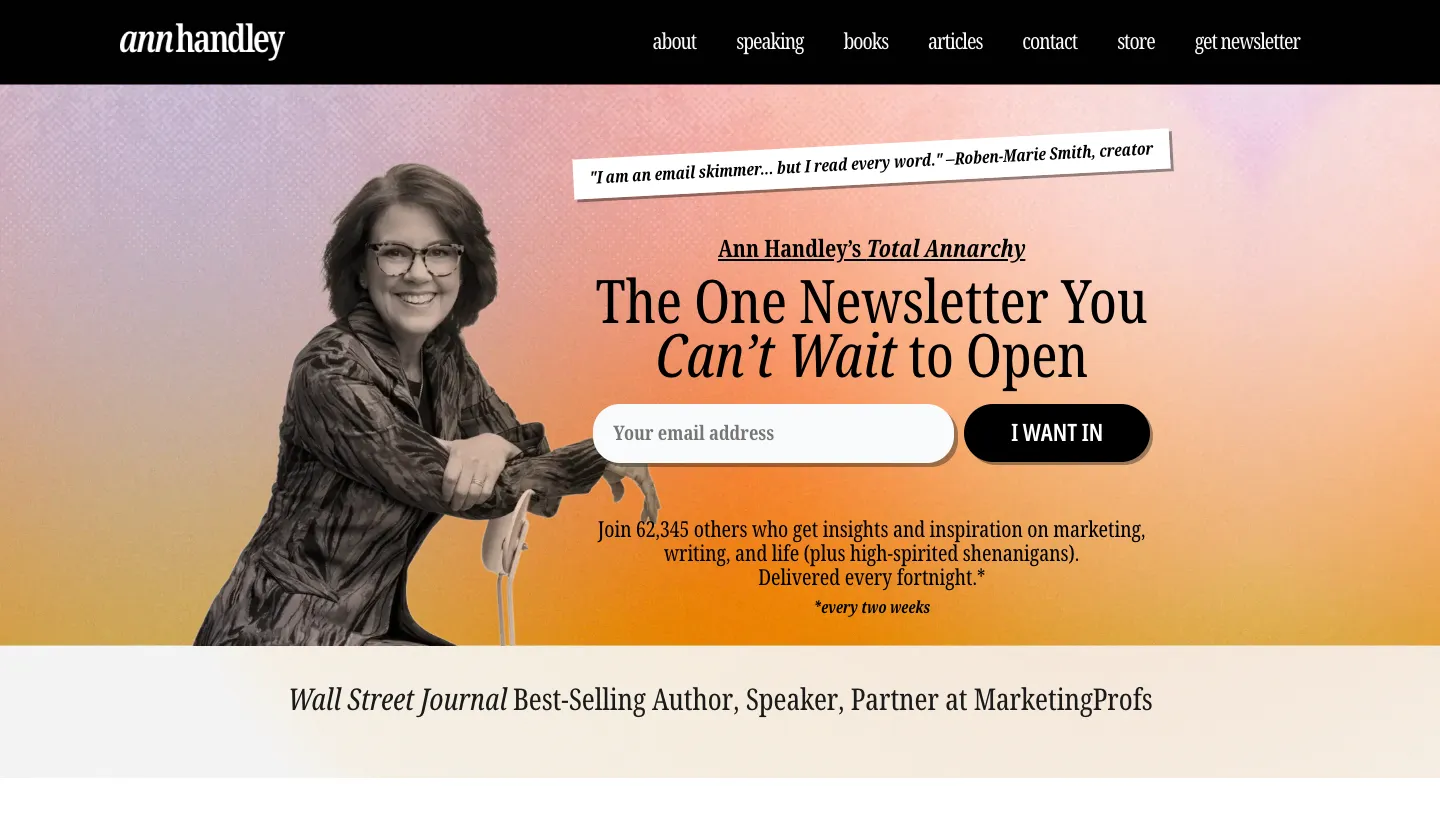
Ann Handley's site opens with a sign-up for her fortnightly newsletter, Total Annarchy, noting that it goes to 62,345 others. It then lists her as a Wall Street Journal best-selling author, speaker and partner at MarketingProfs, with logos of companies she has worked with.
This is the far end of the scale: a writer whose books, newsletter and talks are the portfolio. The lesson for everyone else is the order. Proof comes first, then the offer.
Borrow this: put your strongest single proof point, whatever it is, in the first screen.
7. Kaleigh Moore: a clear offer for a clear buyer

Kaleigh Moore opens with "Get cited in AI answers through the experts your buyers already trust." and says she helps B2B SaaS teams. Below, she sets out three ways to work together, from an audit to a sprint and executive training, and mentions writing for Forbes, Vogue Business and ADWEEK.
A named buyer and three clear packages make it easy for the right client to say yes.
Borrow this: name the type of client you work best with in your headline, and offer two or three fixed ways to start.
How to build your own portfolio
Choose six to ten pieces that show the range of work you want more of, not everything you have written. For each one, write a sentence on the client, the job and the result if you have it. Add your best testimonials next to the work they describe. Then make sure the homepage line, the about page and the contact page all sound like you.
If you have little client work yet, write spec pieces for brands you admire and label them clearly as spec. A newsletter or blog also counts, as long as it shows the kind of writing you want to be hired for.
What to leave out
Pieces you are no longer proud of, work in a niche you want to leave and long lists of every client you have ever had all make the portfolio weaker. A short portfolio of strong work beats a long one with filler. If a piece needs a paragraph of explanation before it makes sense, it probably isn't one of your best.
Measure what matters
Track enquiries and where they came from. Ask every new client which piece of work convinced them. After a few months, you will know which samples do the selling and which can go. Update the portfolio at least twice a year so the work on show is recent.
Questions to ask before hiring a web designer
Have you worked with writers before? Will the design leave room for the words, or compete with them? How will I add new portfolio pieces? Who writes the copy, and will it sound like me? Who owns the website and content?
The short version
A copywriter's site is the first sample a client reads. The strongest portfolios show work with one-line descriptions, lead with results where they can, sound unmistakably like the writer and use an audience as proof. Choose fewer, better pieces, name the clients you want and make hiring you easy. Our page on website design for copywriters shows how we build these sites.
FAQ
What should a copywriter portfolio include?
Six to ten pieces that show the work you want more of, a one-line description of each job and its result, testimonials, an about page in your own voice and a clear way to hire you.
How do I build a copywriting portfolio with no clients?
Write spec pieces for brands you admire and label them as spec, start a newsletter or blog, or take on a small project for a local business or charity to get real work to show.
Should a copywriter's website show results?
If you can, yes. Business owners hiring a writer often care most about outcomes. Even one or two results with numbers make a portfolio more persuasive.
How many pieces should a copywriting portfolio have?
Usually six to ten. Enough to show range in the work you want, few enough that every piece is strong.
What if my best work is under NDA?
Say so plainly, describe the type of work without details, and list the brands or agencies you have worked with where you are allowed to.
How much does a copywriter website cost?
It depends on what is included. Our Hosted for You plans, which include the design, hosting and every change you send, start from $197 a month billed yearly.