



Below that range you're buying a template with your logo swapped in. Above it you're usually paying for custom development the average architecture practice doesn't actually need.
1. The real price range and what separates the tiers
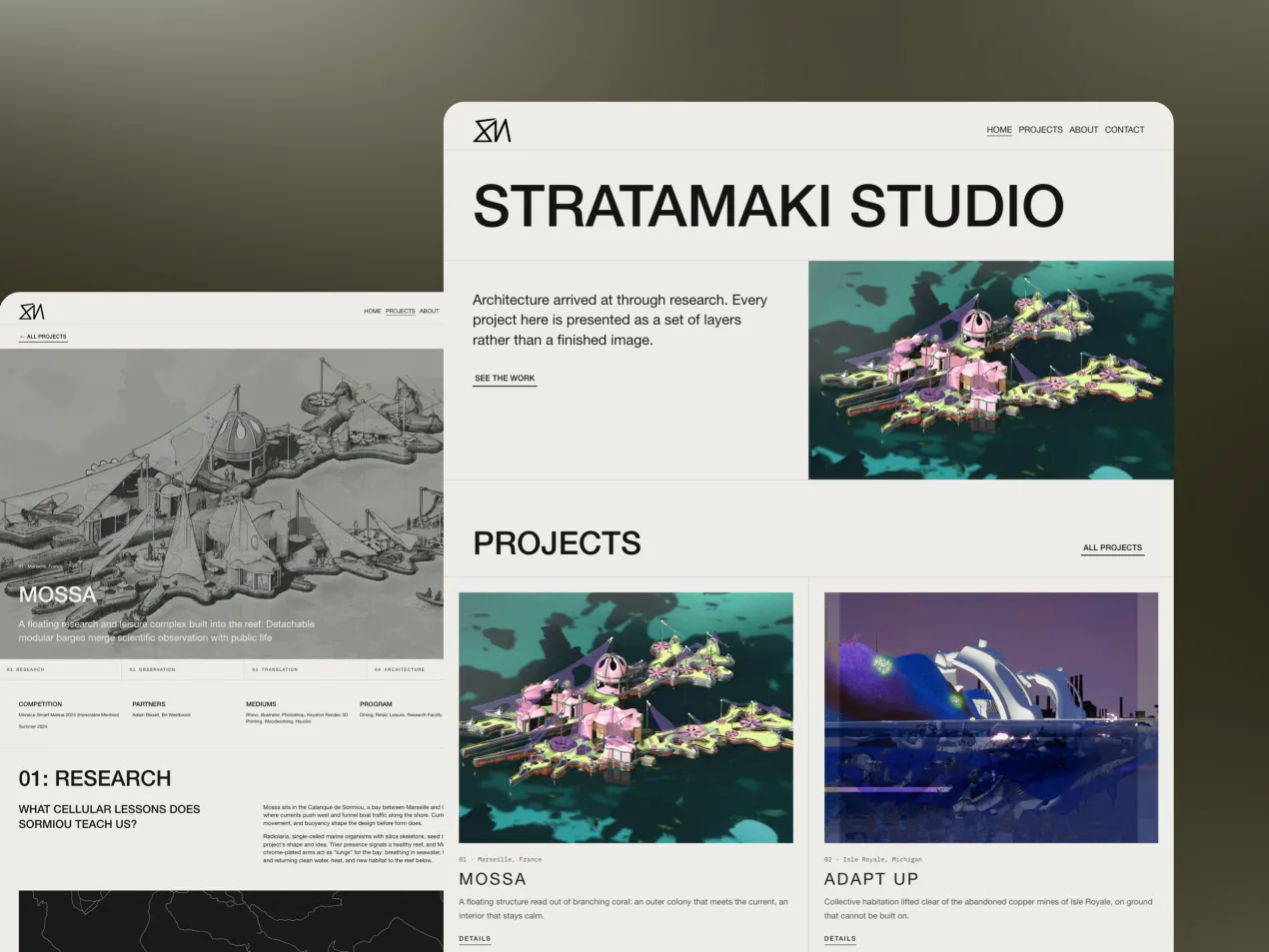
At the low end, $800 to $2,500 typically buys a pre-built template with placeholder sections filled in with your content. The design work is minimal because the template already exists. In the $3,000 to $6,000 range, you're paying for a designer to build a site specific to your practice, usually on a platform like Squarespace, with copywriting support and a layout built around your actual portfolio rather than a generic structure. From $6,000 to $12,000, that work extends to full brand positioning, detailed project page templates, SEO strategy, and often a few rounds of content for service and process pages. Above $12,000, you're usually into custom code, bespoke interactions, or an agency with higher overhead, which is sometimes justified and often isn't for a firm of under fifteen people.
Firms get confused in this range because the visible output, a homepage and a portfolio grid, can look similar at $2,000 and $10,000 from a screenshot. The difference shows up in how the site performs for leads six months later, not in the first impression.
2. What drives the cost up
Custom project page templates that let you add structured detail (site, concept, materials, outcome) for each project cost more than a generic gallery, because someone has to design and build a system that holds that information well across dozens of future projects, not just the five you're launching with. Original copywriting, written by someone who understands how to write architecture firm website copy that converts rather than filled in with placeholder text, adds real cost because it takes real time and skill.
SEO setup, including schema markup, keyword research, and properly structured service pages, adds cost but pays for itself faster than almost anything else on the list, because it's the difference between a site that gets found and one that just sits there looking nice. Photography retouching, video, and interactive features like filterable project galleries also add cost, and are worth it for some firms and unnecessary for others depending on portfolio size.
3. What drives the cost down without hurting quality
Using a platform like Squarespace instead of fully custom code brings costs down significantly without sacrificing design quality, because the platform handles hosting, security, and a lot of the technical plumbing a custom build would need to handle manually. This is the biggest lever available to most architecture firms, and it's why so many premium-looking architecture sites are built on Squarespace rather than from scratch.
Reusing and reorganizing existing photography instead of commissioning new shoots keeps costs down when your current project photos are good but poorly presented. Starting with a smaller, well-chosen set of flagship projects rather than trying to launch with every project you've ever done also reduces both cost and timeline, and a focused five-project portfolio usually converts better than a scattered fifteen-project one anyway.
4. The ongoing costs nobody mentions upfront
A website isn't a one-time purchase. Domain registration runs $15 to $20 a year. Squarespace hosting plans run roughly $200 to $500 a year depending on the plan and whether you need e-commerce features, which most architecture firms don't. Beyond that, budget for periodic content updates as you complete new projects, because a portfolio that stops growing looks like a practice that stopped working, which is its own credibility problem regardless of how good the original design was.
Some firms also retain their designer for a small monthly fee to handle updates, which usually runs $100 to $400 a month depending on how much changes. This isn't mandatory, Squarespace is built to be editable without a developer, but firms that are busy running projects often prefer to hand it off rather than learn the platform themselves.
5. What a bad cheap website actually costs you
The real cost of an $800 template site isn't the $800. It's the enquiries that never come in because the site doesn't rank, doesn't convert hesitant visitors, and doesn't hold up against a competitor's site when a prospective client is comparing three firms side by side. A single missed commission from a mid-size residential project is worth more than the entire cost difference between a cheap site and a properly built one, often several times over.
This is the core argument behind what DIY website builders actually cost an architecture firm: the sticker price of a cheap or self-built site is real, but it's rarely the number that matters most. What matters is whether the site generates the enquiries a firm needs to grow, and a generic template built in an afternoon almost never does.
6. How to know you're being quoted fairly
A fair quote breaks down what you're paying for: design hours, copywriting, SEO setup, number of page templates, and revision rounds included. A vague flat number with no breakdown is harder to evaluate and easier to overpay for. Ask specifically whether copywriting is included or extra, because this is the single most common hidden cost in website quotes across every industry, not just architecture.
Compare quotes on scope, not just price. A $4,000 quote that includes strategy, copy, and SEO setup is a better deal than a $3,000 quote that's design only, because the $3,000 site will need those other pieces eventually anyway, usually at a worse rate once it's being added on after launch. If you're still deciding between a fully custom build and a well-executed template-based site, that's a separate decision worth making deliberately, which we cover in custom website vs. template for an architecture firm.
Conclusion
Work out what one good commission is worth to you, and what you'd spend to win one more a year. Compare that with the quotes, and ask each provider what's included. These ranges are a rough guide, so your own numbers should decide it.
FAQ
Is $800 enough for a decent architecture website?
It is enough for a basic template site, but not for custom project templates, original copywriting or SEO setup. At $800 to $2,500 you typically get a pre-built template with your content dropped into placeholder sections, so the design work is minimal. Sites at $2,000 and $10,000 can look similar in a screenshot. The difference shows up in how they perform for leads six months later, so expect a second investment to fix what is missing.
Why do some architecture website quotes go above $15,000?
Usually because of custom code instead of a platform like Squarespace, bespoke interactions or agency overhead. The post puts that tier above $12,000, and says it is sometimes justified but often isn't for a firm of under fifteen people. Below it, $6,000 to $12,000 covers a fuller custom build on a platform. Squarespace handles hosting, security and much of the technical work a custom build would have to cover by hand.
Does the cost include copywriting?
Not always, so ask directly. Copywriting is one of the most commonly excluded line items and one of the most important for winning enquiries. A fair quote breaks down what you are paying for: design hours, copywriting, SEO setup, number of page templates and revision rounds. A flat number with no breakdown is harder to judge and easier to overpay for.
How much should I budget per year after the site launches?
Plan for domain registration at $15 to $20 a year and Squarespace hosting at roughly $200 to $500 a year, depending on the plan. Most architecture firms don't need the e-commerce features that push the price up. Beyond that, budget for content updates as you finish new projects, or a retained designer if you prefer. A portfolio that stops growing looks like a practice that stopped working.
Is a cheaper website ever the right choice?
Yes, for a brand-new solo practice with no completed projects and no budget to spare. A simple, honest starting site is better than waiting, but plan to upgrade once there is real project work to show. You can also keep costs down without hurting quality. Reuse good existing photography and launch with a small set of flagship projects, since a focused five-project portfolio usually converts better than a scattered fifteen-project one.